|
|
Farm Photos of the Week
September 26, 2005
Photos by Debbie
Roos, Agricultural Extension Agent.
2005 Extension Farm and
Industry Tour
Chatham County, NC
Every year the Chatham County Center of North Carolina Cooperative
Extension conducts a Farm and Industry Tour for local residents.
The stops change every year and usually include a vegetable farm,
a livestock operation, a nursery or greenhouse, and an industry
stop. Each year we pick a different part of the county to tour.
This year's tour had about 75 participants and included department
heads from Chatham County government.
|
The Grahams moved to North Carolina in the mid-1980s from the
South Pacific. The farm started as 50 acres of woodland and pasture.
They built a woodworking shop and slowly developed the gardens.
The Grahams discovered that the Asian vegetables that they grew
for their own table were a big hit among Southeast Asian customers
at the Carrboro Farmers' Market. Dan and his son Louis also have
a sawmill and cut their own cedar to produce a variety of cedar
products including chests, armoires, tables, stools, and much
more. Visit
their website to learn more about the woodworking side of
the farm and to see photos of the beautiful cedar products.
Check out the News
& Observer article about the Extension Farm Tour on the
Graham Family Farm...
|

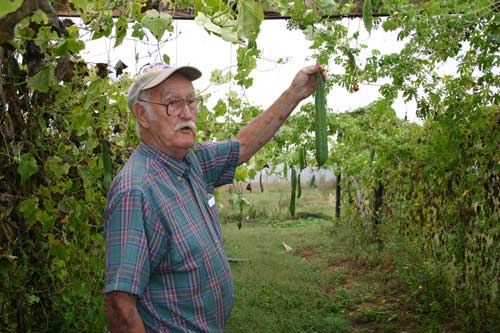
| Dan Graham shows one of his edible
luffas, also called Chinese okra or vegetable sponge. The young
gourds are edible and popular in the Asian community. |

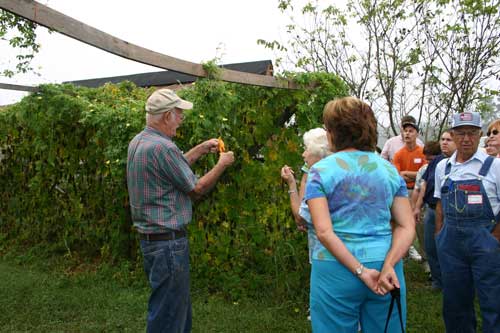
| Farm tour participants listen
as Dan talks about production of bitter melon. Bitter melon is one
of the most popular vegetables in China, Taiwan, Vietnam, India
and the Philippines. Most Americans consider it an acquired taste! |

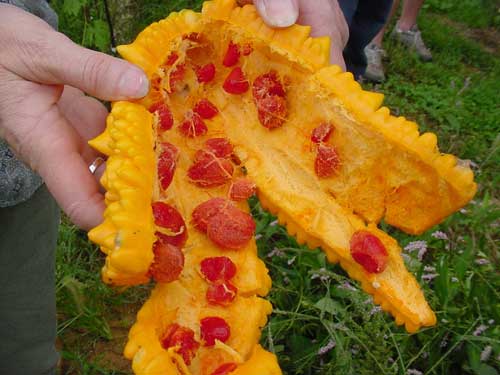
| The ripe fruit and seeds of a
bitter melon. Bitter melon is also used medicinally in the U.S.
and worldwide. |

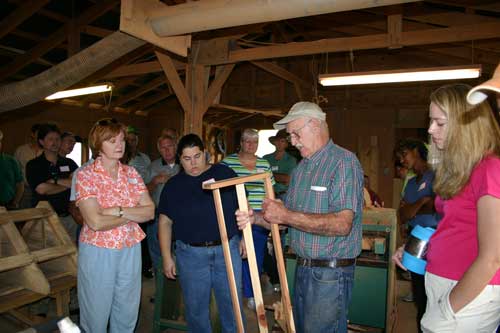
| Dan talks about his woodworking
projects while holding a shoe rack. Dan and Louis have invented
many "appropriate technology" devices to produce their
products more efficiently. |

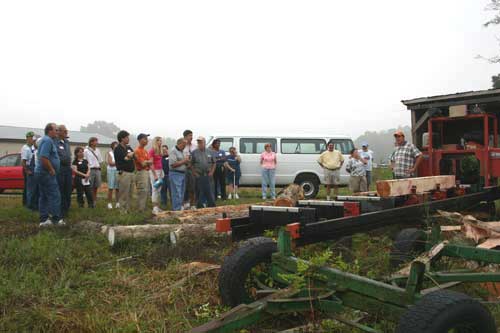
| Louis talks about their sawmill
which is used to cut all the wood needed for their woodworking projects.. |

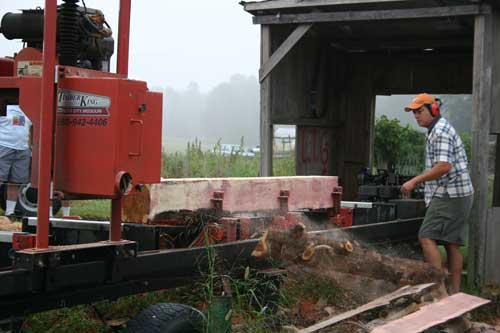
| Louis demonstrates the sawmill
making short work of a cedar log. Every part of the logs is used,
so nothing is wasted. All the cedar planer shavings and scrap blocks
are bagged in hosiery materials and retailed in the farmer's market
as sachets to act as insect repellents. Even the sawdust is sold
as incense and for ant repellent in mulches.
|
Biodiesel is an alternative diesel fuel made from vegetable oil
or animal fats and is completely renewable. It is non-toxic, biodegradable,
and has significantly lower emissions than petroleum diesel. Piedmont
Biofuels Industrial was formed when members of the Piedmont Biofuels
cooperative discovered an abandoned chemical plant on the edge
of Pittsboro and decided it would be a great place for commercial
biodiesel production. The plan is to recycle/convert one of the
buildings into a one million gallon capacity biodiesel facility.
Visit the Piedmont Biofuels website
to learn more about this great organization.
See Piedmont Biofuels co-op
members harvesting oilseed crops...
|

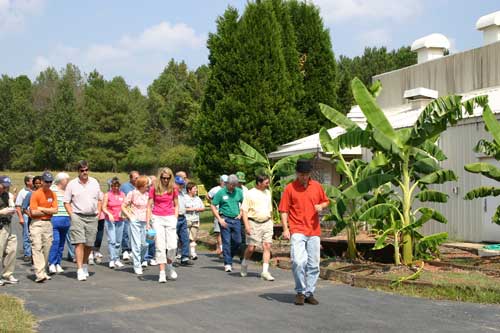
Lyle Estill (in top hat), one of the founding members of Piedmont
Biofuels, leads tour participants through the industrial park.
Piedmont Biofuels has attracted other like-minded businesses to
set up shop in the industrial park, and each building has its
own unique garden (note the bananas above).
|

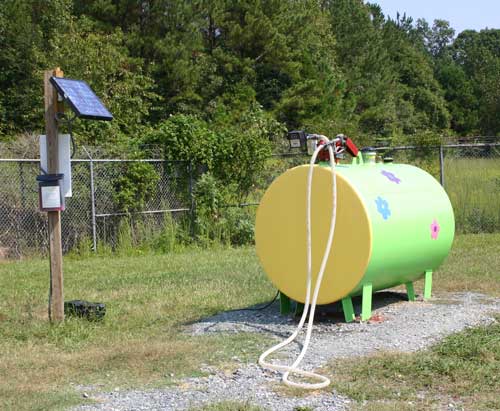
| A solar-powered pump for dispensing
biodiesel fuel to members of the cooperative. The cooperative sells
B100 fuel, which is 100% biodiesel. They have several pumps throughout
the Triangle. |

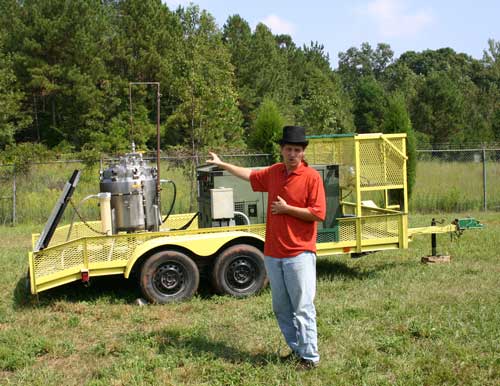
| Lyle describes the small-scale
biodiesel production unit which travels far and wide for demonstrations.
The unit is capable of producing about 30 gallons of biodiesel from
used vegetable oil. The portable unit was purchased with a grant
from the state energy office. |

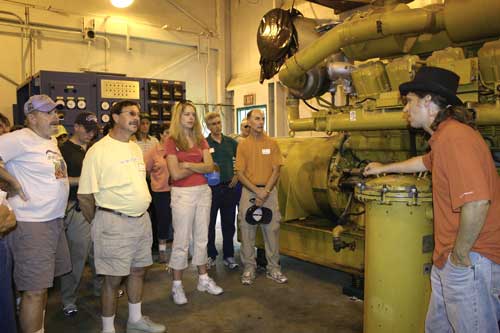
| Lyle talks about the huge diesel
generator inside the industrial complex. The generator will run
on waste vegetable oil and/or biodiesel. It will provide heat and
electricity for the biodiesel plant. |
This page last updated August 17, 2008.
|
| 
URL:
www.growingsmallfarms.org
North
Carolina Cooperative Extension is an educational partnership helping people
put research-based
knowledge to work for economic prosperity, environmental stewardship and
an improved quality of life.
|