Written by Brenda F., Extension Master Gardener℠ Volunteer of Chatham County
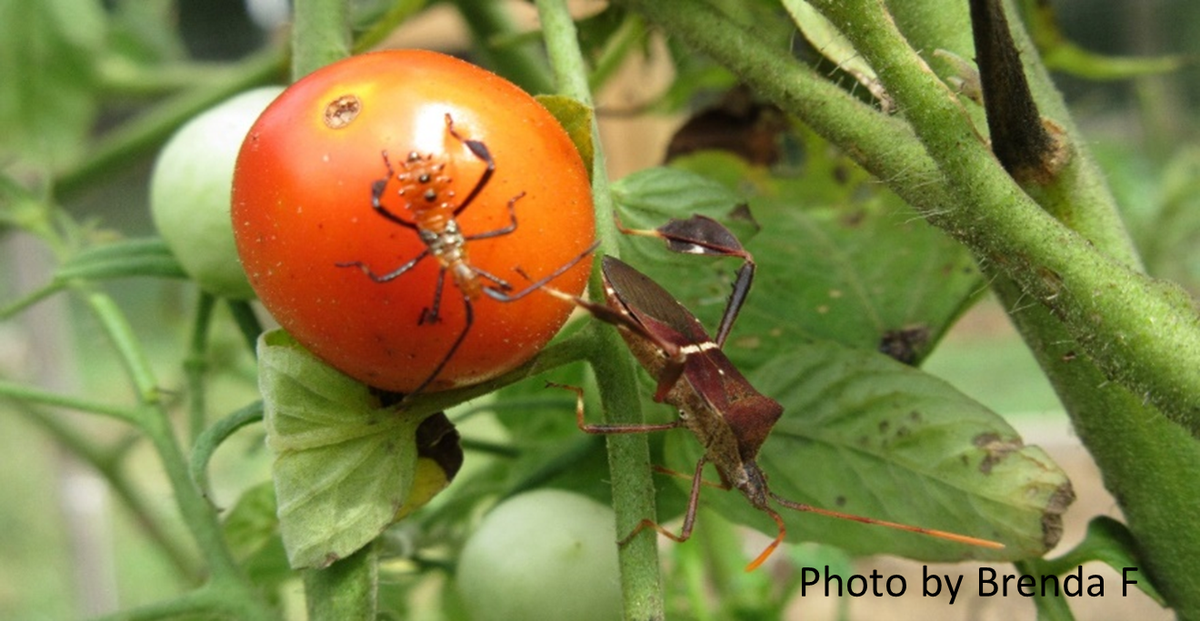
Have you been out to the garden and noticed some leggy insects hanging around? Maybe you saw an insect that looks similar to a stink bug, but doesn’t look quite right? Have you noticed soft spots on your tomatoes? If so, you may be dealing with an infestation of leaf-footed bugs (Leptoglossus phyllopus).
Life cycle – Multiple generations a year
Eggs: laid in rows, golden brown, cylindrical, about 20 at a time, along a leaf vein
Nymphs: young nymphs are bright orange red with black legs. Older nymphs look like adults except they are smaller, with no wings and slender back legs.
Adults: greenish gray to black, about ¾ inch long, points on area thought of as shoulders, white band across area thought of as waist. Wide, flat hind legs. Emit a distinctive odor. Overwinter as adults in overgrown areas.
Food – Feed on apple, bean, bear grass, bell pepper, blueberry, blackberry, cowpea, crape myrtle, cucurbits, eggplant, Gerbera daisy, gladiolus, grain sorghum, hibiscus, ligustrum, loquat, oat, okra, peach, pear, pecans, persimmon, pinecones, plum, potato, roses, sunflowers, tomato, and, to a lesser extent, rye, wheat, barley, and soybean. Also infest elderberry, goldenrod, jimsonweed, and thistle.
Tomatoes – Uses mouthparts to pierce fruit, which causes discolored depressions and creates a place for secondary infections such as anthracnose to infect the fruit. The fruit eventually becomes soft and mushy. Easy to spot insects because they congregate in large numbers.
Control- Best option: Knock insects into soapy water.
- Use insecticidal soaps on plants (more effective on nymphs).
- Insecticides that can be used on tomatoes are bifenthrin, cyfluthrin, malathion, or cypermethrin but these insecticides are highly toxic to bees. Follow all label directions, make sure the product is labeled for use on edibles, and read the warnings on how to reduce harm to pollinators.
- Eggs are preyed on by fire ants and snowy tree crickets.
- Three species of tiny wasps parasitize eggs.
For more information, see: